AI Outbound Voice vs. Email vs. SMS: Which Channel Actually Drives Revenue in 2026?
Your marketing team pushes email. Your sales team swears by phone calls. Your operations team relies on SMS. Everyone has an opinion, but no one has the data.
When it comes to driving revenue—not just opens or clicks—the gap between channels is wider than most businesses realize. The global intelligent outbound calling market is projected to exceed $15 billion in 2026, with penetration rates hitting 85% as AI voice technology moves from "nice-to-have" to mission-critical infrastructure.
This guide breaks down when to use each channel, and how AI-powered voice is changing what’s possible for outbound engagement in 2026.

What the Data Says
| Channel | Open/Answer Rate | Response Rate | Conversion Rate | ROI per $1 Spent | Best Use |
| SMS | 90–98% | 30–45% | 2–5% | $71 | Simple s, verification |
| 15–25% | 2–5% | 1–3% | $36 | Formal communication, documentation | |
| Voice (Human) | 15–25% (cold) | 8–15% | 2–7% | Varies | Complex conversations, high-touch sales |
| AI Voicebot | 20–35% | 15–30% | 15–40% | 3.2x in first 90 days | Personalized outreach, follow-ups, reminders |
The standout number? AI voicebots delivering 15–40% conversion rates in marketing and invitation scenarios—significantly outpacing both human calls and digital channels. According to recent industry benchmarks, 80% of organizations report that AI voice deployment increases outbound efficiency by 3x or more while reducing labor costs by 40–60%.
When to Use Each Channel
• SMS: Speed and Simplicity. Best for appointment reminders, two-factor authentication, order updates, and urgent s. With 98% open rates and $71 ROI per dollar spent , SMS dominates for time-sensitive, low-complexity messages. Not ideal for complex questions or emotional conversations.
• Email: Formal and Document-Oriented. Best for detailed ations, return instructions, policy explanations, and documentation that needs a paper trail. Email delivers reliable ROI at $36 per dollar spent and excels at nurturing long-term relationships. Not ideal for immediate answers or two-way conversation.
• Voice (Human): High-Touch, High-Intent. Best for complex troubleshooting, high-value sales conversations, sensitive issues, and escalated customer concerns. The challenge: human calls are expensive and inconsistent. The average cold call success rate is just 2.7% , though top teams achieve 11.3%.
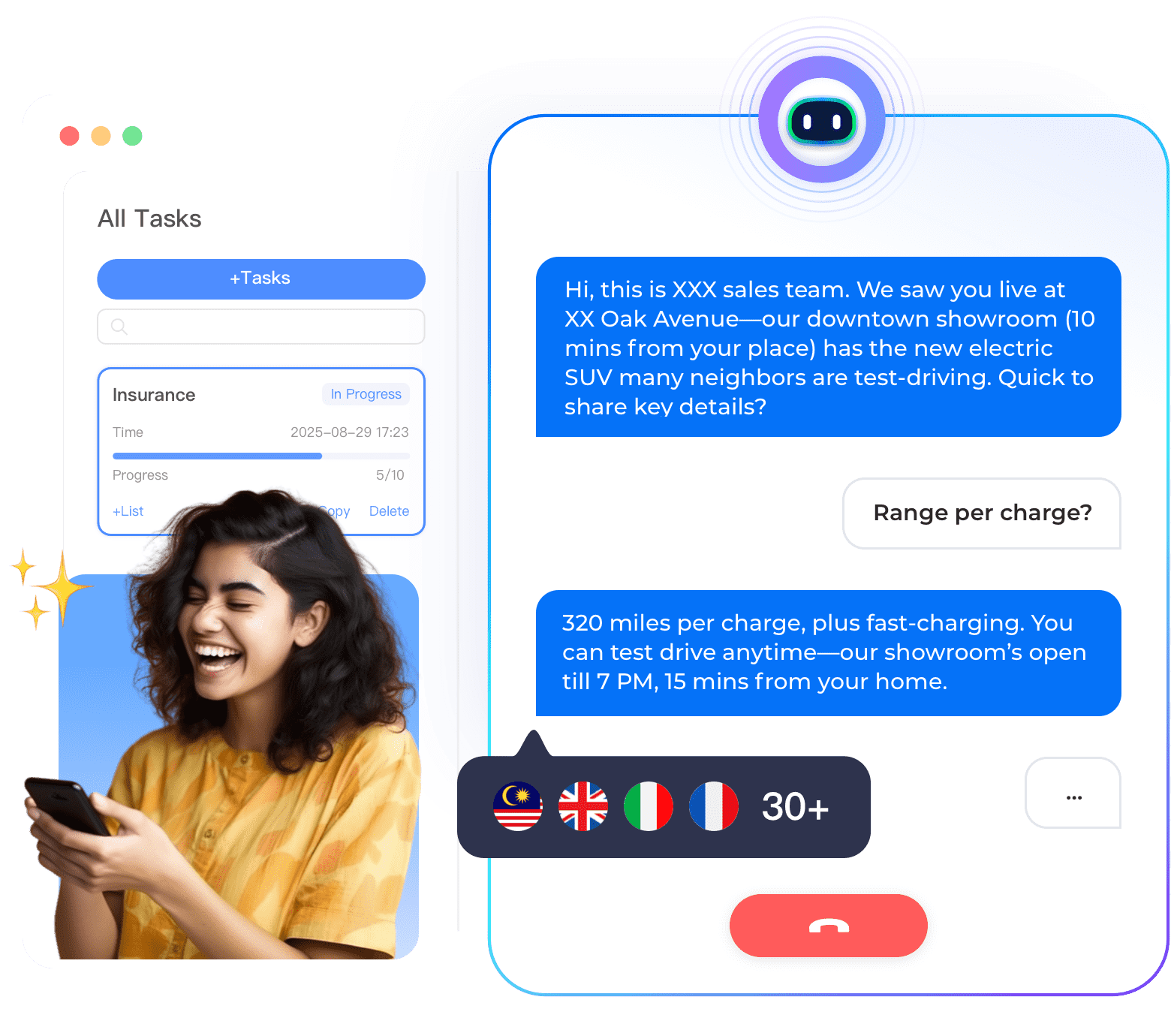
• AI Voicebot: The New Middle Ground. Best for lead qualification, marketing invitations, payment reminders, appointment ations, and post-purchase follow-ups. AI voicebots combine the personal touch of voice with the scalability of digital channels—handling thousands of calls simultaneously while maintaining natural conversation flow.
In marketing campaigns, AI voicebots achieve conversion rates up to 40% higher than traditional approaches. One campaign reached 500,000 members in two days—13× faster than manual efforts. For financial services, AI voicebots have increased conversion rates by over 30% in marketing scenarios.
Why Engagement Quality Matters More Than Volume
Not all engagement is equal. Plenty of opens or clicks doesn't always translate to revenue. What matters is the quality of engagement—whether your audience takes the next action that leads to a sale.
Users who engage in a two-way conversation with an AI voice assistant are often more purchase-ready than those who simply click an email link. This discrepancy in engagement quality explains why AI calls consistently outperform SMS and email on ROI, even with higher per-interaction costs.
Strong engagement also builds trust. When you understand and assist prospects in real time, they move through your sales funnel faster. SMS and email create volume; AI voice creates conversation—and conversation drives deals.
The Omnichannel Reality
Here's what's changed: single-channel communication is now obsolete for global brands. Ten years ago, 73% of platform traffic went through one channel. By 2025, that figure dropped to just 2.3%—nearly 98% of customer interactions now span multiple channels.
Your customer doesn't think in channels. They text you at 9 PM, expect a call back the next morning, and follow up via email—all as part of one conversation. But if your system treats those as three disconnected interactions, you're losing context and momentum.
The business impact is stark: companies with strong omnichannel strategies retain 89% of customers, compared to just 33% for those with weak engagement. For B2C sales teams, this translates directly to more deals closed and less revenue left on the table.
Why Voice Has Changed
Traditional cold calling had a 2.7% success rate because it was intrusive and impersonal. Modern AI voicebots flip the script:
• 24/7 availability reaches customers at convenient times
• Intelligent interruption handling (<2 seconds) makes conversations feel natural
• Emotion-aware responses adjust tone based on customer sentiment; leading platforms achieve 85%+ emotion recognition accuracy
• Multilingual capability (30+ languages) serves global audiences
• Sub-300ms latency creates seamless conversation flow that feels human
The technology has matured to the point where leading AI voice platforms achieve 94% comprehension across major language variants and maintain context across 15+ conversation exchanges without degradation.
Putting It All Together
The question isn't whether voice, email, or SMS is "better." It's what you're trying to accomplish:
| Goal | Primary Channel | Secondary Channel |
| Urgent problem resolution | Voice (human or AI) | SMS (initial ) |
| Marketing invitation | AI Voicebot | Email follow-up |
| Payment reminder | AI Voicebot | SMS backup |
| Complex sales conversation | Human voice | Email (documentation) |
| Simple update/ ation | SMS | |
| Post-purchase follow-up | AI Voicebot | SMS survey |
The brands winning in 2026 aren't abandoning any channel. They're using each where it works best—and connecting them so customers move seamlessly between them. With AI voicebots delivering 10× efficiency and 40% higher conversion, the economics of voice have fundamentally changed. The question isn't whether you can afford to adopt AI voice. It's whether you can afford not to, while your competitors already have.
Tags
Share This Article


Chris
Senior Customer Service Operations Analyst
You may also like

Outbound Robot for Insurance Telemarketing:A Guide for Insurers
Insurance telemarketing involves high-volume outbound calls to prospects for policy sales,lead qualification,and appointment setting.An outbound robot—an AI-powered voicebot—automates these calls,engaging prospects in natural conversations,addressing objections,and scheduling follow-ups.Unlike human agents,who can only make a limited number of calls per day,outbound robots can handle thousands of calls simultaneously,reducing the cost per lead and improving conversion rates.This article explores how insurers can use outbound robots for telemarketing,their benefits over manual calling,and how Instadesk’s VoiceBot platform delivers compliant,effective outbound automation.


Voice Bot with Data Encryption:A Guide for Fintech Companies
Fintech companies handle sensitive customer data—account numbers,transaction histories,credit scores,and personal identifiers.A voice bot with data encryption ensures that all customer conversations and data exchanges are protected from unauthorized access.Unlike standard voice bots that may store or transmit data insecurely,encrypted voice bots use advanced encryption standards(AES)for data at rest and Transport Layer Security(TLS)for data in transit,meeting financial industry compliance requirements.This article explores the importance of encryption in voice bots,how encrypted voice bots differ from standard ones,and how Instadesk’s VoiceBot platform delivers bank-grade security for fintech applications.


VoiceBot Inbound Call: A Guide for Property Management Companies
Property management companies handle thousands of inbound calls from tenants,landlords,and vendors—including maintenance requests,rent inquiries,lease questions,and emergency reports.An inbound VoiceBot system automates these routine interactions,providing 24/7 service while reducing agent workload.Unlike traditional IVR menus that frustrate callers,AI-powered voicebots understand natural language,answer questions,and even create maintenance tickets automatically.This article explores how property management companies can leverage inbound voicebots,their advantages over traditional systems,and how Instadesk’s Inbound Voicebot platform delivers efficient,tenant-friendly automation.
Get Started in Minutes. Experience the Difference.